%25202.avif&w=640&q=75)
The All-in-One Decommissioning Option: A Retail Insider’s Perspective on Who to Hire
When a business needs to run a store decommission, there is no shortage of decisions to make, and one of the biggest is who you trust to handle it. For many retailers, this often comes down to deciding between hiring a general contractor or partnering with a larger retail service provider like us at Mid-America Store Fixtures.
It should come as no surprise which of the two options we strongly believe in, but what we believe in even more is making sure our customers are fully informed. We always aim to give our potential customers a clear understanding of what each option actually brings to the table, so decisions like these can be made with confidence.
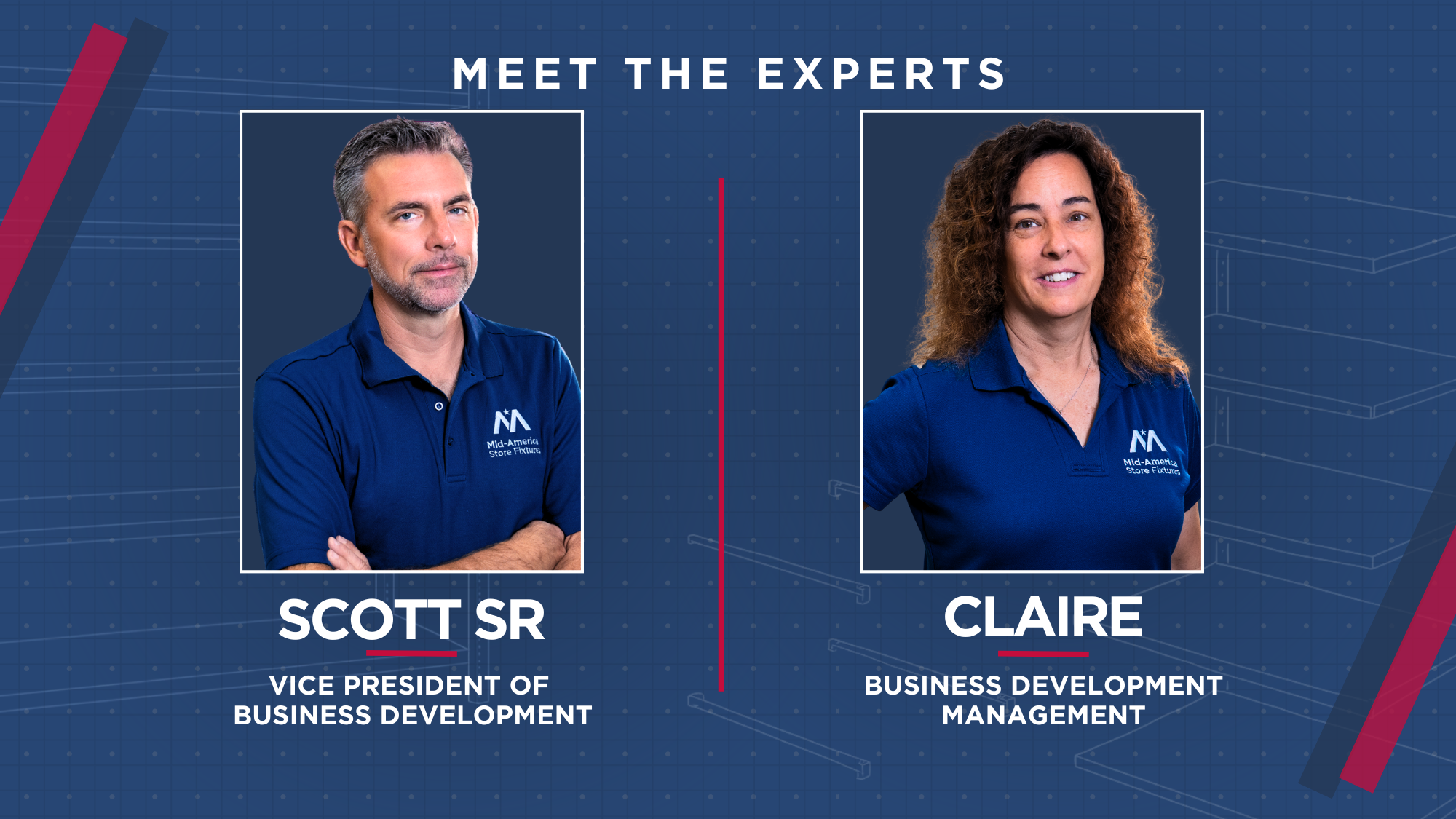
That’s why we’re excited to share this conversation with one of our team members, Claire Hornberger, who brings a valuable and unique perspective. Before joining MASF as a Business Development Manager, she worked at Rite Aid as a Property Administrator, where she was responsible for overseeing store closures and hiring vendors to handle decommissions—a role that ultimately led her to partner with Mid-America.
Naturally, both to share this with you and to better understand it ourselves, we wanted to pick her brain to get an inside perspective on what drove those decisions: what worked, what didn’t, and why Mid-America ultimately stood out.
So, we sat down with Claire, along with Scott Hoek Sr., our Vice President of Business Development, to talk through the realities of decommissioning, the role general contractors can play, and where a specialized partner can make all the difference.
What General Contractors Do Well
First, we wanted to better understand the client’s perspective on the role general contractors typically play in projects like these. They’re a viable choice for a reason when it comes to decommissioning, and it’s important to recognize where they bring real value. So, we asked Claire about her experience working with general contractors during her time at Rite Aid.
“General contractors are great at what they do,” she explained. “They repair, build, and fix things. That’s their strength. But decommissioning isn’t their focus.”
She went on to clarify that while GCs are highly capable in their lane, decommissioning requires a different skill set. “They do what they know, and they do it well,” she said. “But they don’t typically handle the salvaging or selling side of things.”
That point stood out to Scott, who added context around how fixtures are often handled by GCs. “They don’t really understand store fixtures,” he said. “A lot of times, they’re just pulling everything out and throwing it away.” In many cases, that means shelving that could be reused, sold, or scrapped for value ends up in a dumpster instead.
As Scott explained, that’s not necessarily due to negligence, but because it falls outside the typical scope of their work. “They’re not focused on that side of it, and they’re not compensated for it,” he said.
Claire summed it up simply: “There’s nothing wrong with hiring a general contractor. You just have to hire them for what they’re meant to do. Decommissioning is a niche.”
When the Wrong Fit Costs You
So, what happens when a non-specialized team is brought in for a specialized job? Claire shared an experience from her time at Rite Aid that helped answer that question.
During a round of store closures in the Pacific Northwest, timing constraints meant Mid-America wasn’t available, so she turned to a general contractor to handle one of the decommissions. What followed, she explained, was a frustrating and costly process.
“They asked me so many questions,” she said. “It became clear pretty quickly that they didn’t really know what they were doing.”
As a result, costs climbed higher and higher as the project went on. “Every step of the way, it was, ‘oh, that’s going to cost more,’” she recalled. By the time the job was finished, the final bill came in at “about five times” the original quote.
Scott recognized that pattern immediately. With general contractors, he explained, costs often build as the scope evolves. “Everything becomes an add-on,” he said, especially when the work falls outside their typical area of expertise.
From Claire’s perspective, this process simply meant “it wasn’t a positive experience” for her. She continued, “Not because they’re bad at what they do, but because this isn’t what they do.”
She summed it up with a simple, but telling comparison: “It’s like hiring a beautician to do a man’s flattop. Barbers are trained to do flattops, beauticians are not, so they get the concept, but they’re not going to get the details.”

That, she said, is the difference between a general contractor and a retail service partner: the details. And in a decommission, missed details can add up quickly in ways that cost you both time and money.
Why Claire Chose Mid-America
With an experience like that, it’s easy to see why Claire leaned toward working with retail service partners during her time at Rite Aid. But what made Mid-America stand out from the rest?
Claire told us that when the responsibility of managing “dark stores,” which included hiring vendors for decommissions, was handed over to her, she was also given a list of options. Mid-America was just one of several—but she developed a preference quickly.
“It didn’t take me very long to choose Mid-America,” she said.
The first thing she pointed to was the day-to-day experience of working with the team. “Patrick (her point of contact) was very easy to work with,” she explained. “The communication, the follow-through, the responsiveness—it was all there. The job was done professionally, and in the end, the invoice was better-looking than most others.”
Beyond communication and execution, she told us that what stood out most was Mid-America’s ability to adapt under pressure.
“If I needed something done, no matter how impossible it seemed, they would put their heads together and make it work,” she said. During a particularly demanding stretch ahead of Rite Aid’s second bankruptcy, Claire was responsible for closing a large number of stores on the West Coast—well beyond the typical volume Mid-America would take on. “I knew what I was asking was above and beyond,” she said, “but they understood the situation and worked really hard to make it happen.”
For Claire, experiences like that made the Mid-America difference clear. “The communication and the quality from Mid-America were top-notch,” she said. Compared to other vendors, she added, MASF’s level of service “left the others in the dust.”
It’s feedback we’re proud to hear. The Mid-America way has always been centered on our core values of reliability, integrity, and service, and we’re glad that came through in Claire’s experience, just as we aim for it to in every project.
Why Scrap Metal Matters
As we discussed what sets Mid-America apart, one topic came up that might not seem obvious at first: scrap metal.
In the context of a decommission, scrap metal refers to the steel fixtures, shelving, and other components that are removed from a store. Instead of being thrown away, those materials can often be recycled or sold, turning what would otherwise be waste into recovered value.
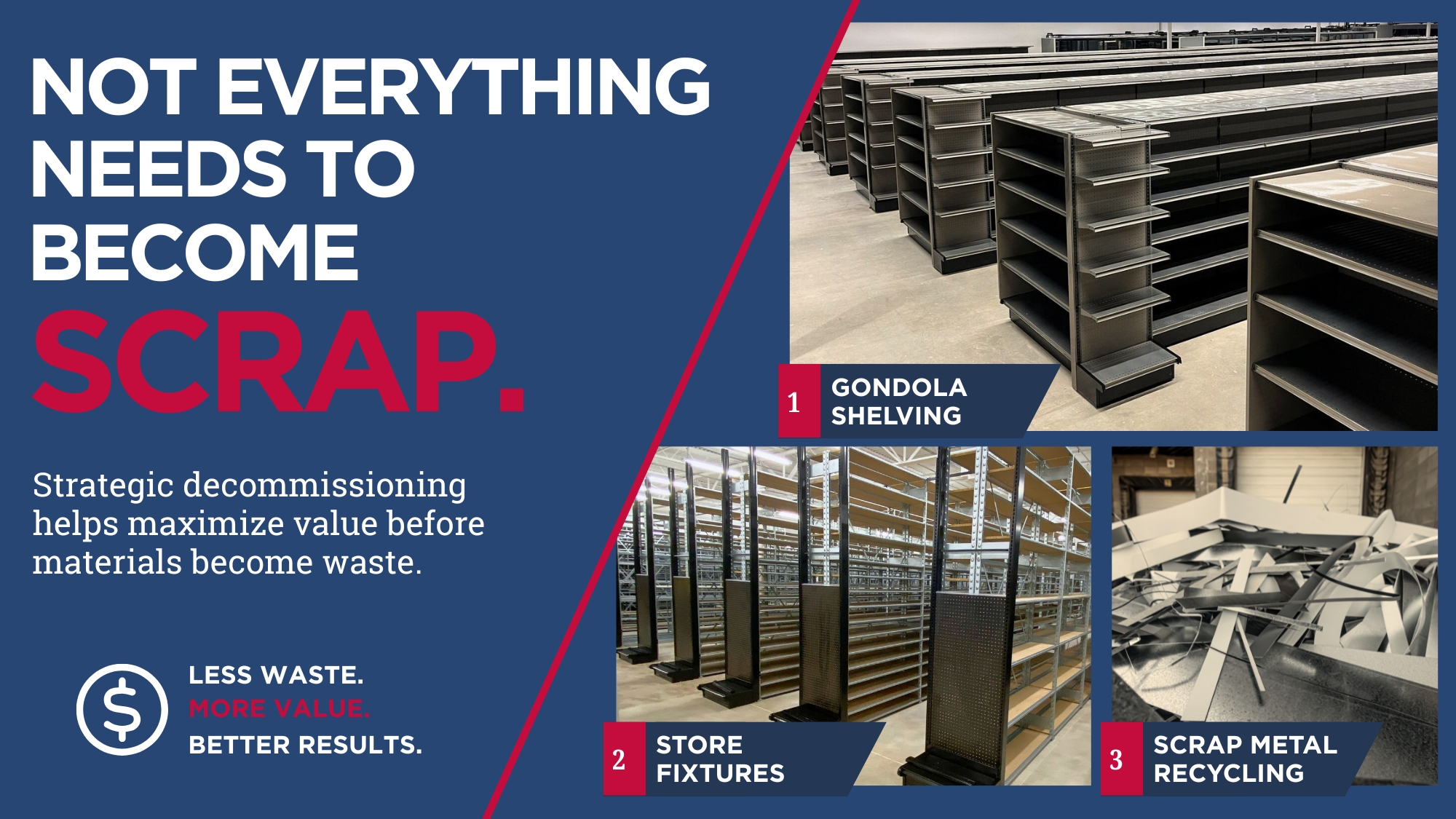
This is a core part of the process for Mid-America, but for Claire, this wasn’t something she fully understood when she took over decommissioning duties at Rite Aid.
“At the beginning, I had no idea,” she said. “But once I became aware of it, it became mandatory. Not only does it help the environment, but it also saves you money. Why not sell it?”
That shift in perspective highlights something important: the way fixtures are handled during a decommission impacts more than just cleanup. It directly affects cost, efficiency, and overall return.
And as Claire learned, not every partner approaches fixtures the same way.
The Mid-America Difference
This naturally segued into the final question we asked both Scott and Claire: if you had to point to one thing that truly sets Mid-America apart from a general contractor, what would it be?
For Scott, the answer came down to a simple but critical concept: motivation to sell.
In regard to decommissions specifically, he said, “One of the biggest differences is that we’re motivated to sell the equipment. We can buy it, we can sell it, and we can properly scrap what’s left—but in every case, the goal is the same: reduce cost for the client.”
Breaking it down further, he explained, “Every time we sell a piece of equipment, the cost goes down for the client. Every time we buy a shelf, the cost goes down. Every time we scrap metal properly, the cost goes down.”
That approach is built into how Mid-America operates. Instead of treating fixtures as waste, they’re treated as assets with potential value. And just as importantly, that value isn’t kept by Mid-America—it’s returned to the client.
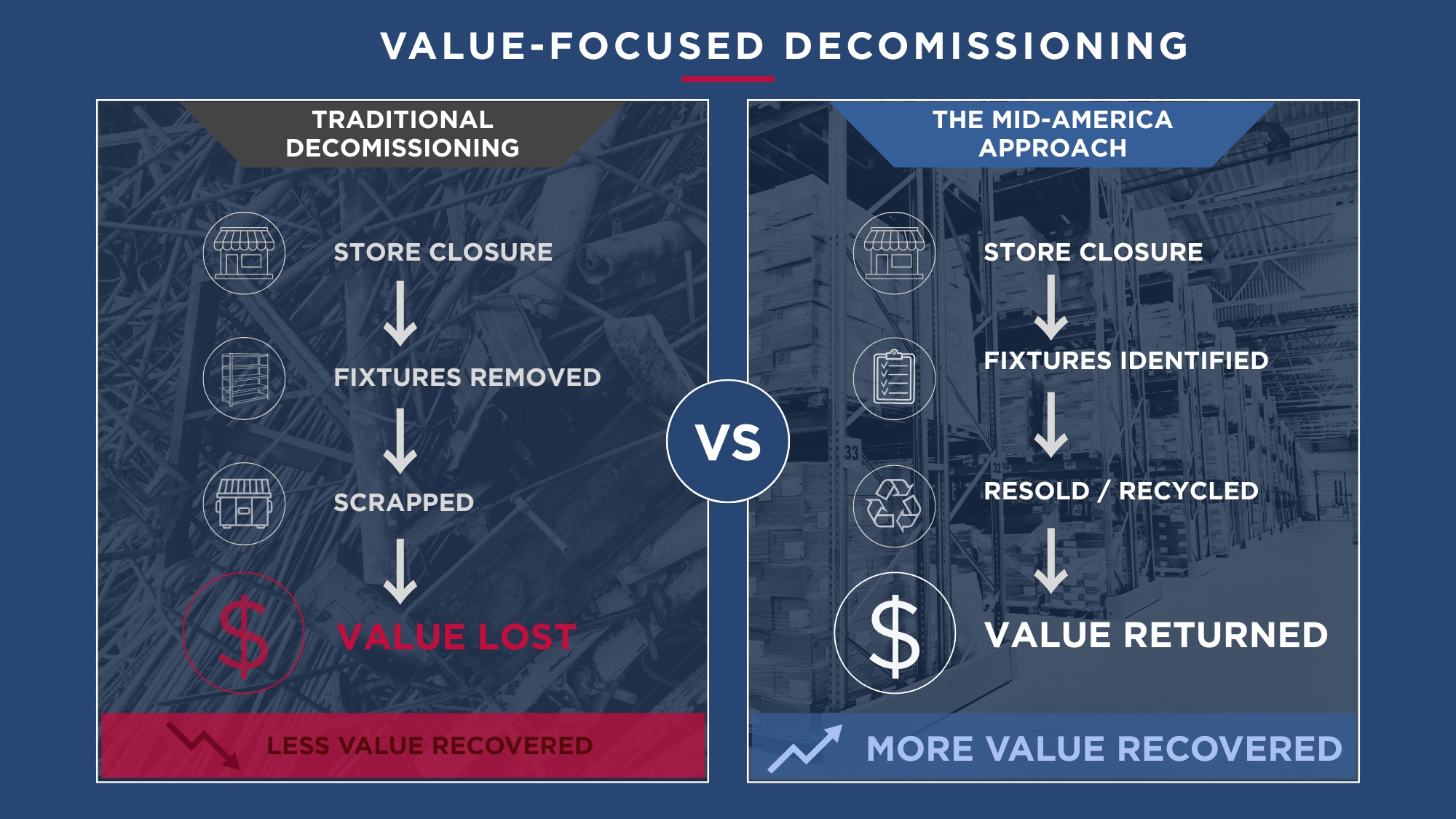
“A lot of liquidators keep the scrap metal,” Scott said. “It’s not even factored into their bid. It’s just assumed they get to keep it. We don’t think it’s our right to take that. We apply those credits back to the client.”
While Mid-America does take a commission, the goal is to split revenue with the client. To show how this plays out in real decisions, Scott pointed out that a contractor might come in with a lower upfront rate, but that doesn’t always tell the full story.
“They might’ve been offering a lower rate,” he said, “but you have to remember that with the right partner, you get to keep 85% of the scrap metal. You could literally be costing yourself $30,000 by choosing a contractor who doesn’t give you your own scrap metal.”
Claire, now working on MASF’s side of that model, added to this by highlighting a key advantage: the size of the network they sell to.
“We don’t just sell locally,” she said. “Mid-America has national connections. We’re not just knocking on the neighbor’s door—we’re reaching a much larger network.” It’s hard to undersell how much that reach matters when it comes to maximizing returns.
Claire also emphasized that she approaches this process with transparency and integrity, staying true to MASF’s core values. “If something isn’t expected to sell well, I’m honest about that,” she said. “We make our money on selling, so we’re going to do everything we can to make that happen—but if it’s not going to, we’re upfront about that.”
Together, that combination of incentive and reach—all done the Mid-America way—defines the MASF difference: a process built not just to clear out a space, but to recover as much value as possible for the client along the way.
Final Thoughts
We hope this conversation, along with Claire’s unique perspective from having been on both sides of the decommissioning process, was as useful to you as it was to us. As we said at the start, our goal with pieces like this is to educate our potential customers so they can make important decisions like these with confidence. If you feel more knowledgeable about your decommissioning options, then we’ve done our job.
That said, if what you’ve learned here has you thinking about your own store's needs, we’re always here as a resource. If you’re considering a decommissioning project or simply have questions you’d like answered, give us a call! Our team would be happy to help.