%25202.avif&w=640&q=75)
What Eddie Bauer’s Closure Reveals About Retail in 2026
For over a century, Eddie Bauer has been one of America’s most recognizable outdoor apparel brands, building its reputation by outfitting generations of customers with gear made for life outside. But recently, that long-standing presence took a major hit as the company filed for Chapter 11 bankruptcy and began the process of closing all 174 remaining physical stores.
This news caught our attention at MASF, as both the factors behind it and the outcome itself reflect broader shifts happening across the retail industry, many of which we explored in our 2026 State of Retail article. Forces like changing consumer expectations and the growing influence of private equity have played a role in a wave of recent closures, and those same dynamics, along with others, appear to be at work here.
In that article, we noted that these forces were unlikely to slow down in 2026, placing increased pressure on leadership teams to make critical decisions about how to move forward—decisions that can ultimately determine whether a brand stabilizes or continues to decline.
With a well-established brand like Eddie Bauer now eliminating its entire physical footprint, it's worth taking a closer look at what led to this moment, how it aligns with the outlook we’ve already laid out for retail in 2026, and what it may signal for the industry moving forward.
Eddie Bauer's 2026 Bankruptcy: By the Numbers
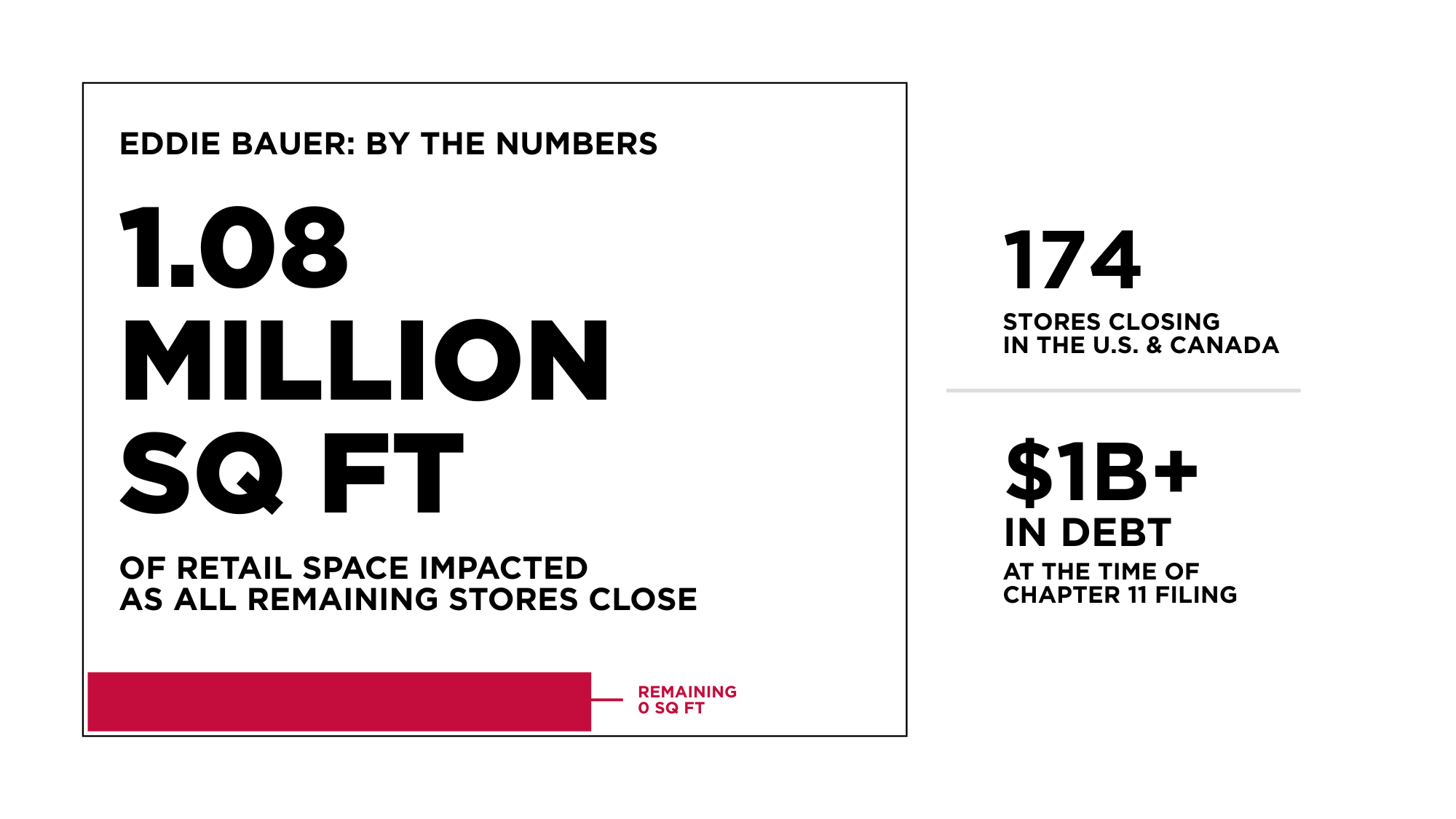
Eddie Bauer’s current situation came into focus in early 2026, when the company filed for Chapter 11 bankruptcy. According to reporting from The Street, the filing officially took place on February 9, 2026, with court documents showing the company carried “more than $1 billion in debt” at the time.
The scale of these closures is significant. Eddie Bauer began the year with roughly 220 stores, but that number quickly dropped as leases expired and closures accelerated, leaving 174 stores across the U.S. and Canada that are now in the process of being shut down. According to the same reporting from The Street, these 174 stores represent “more than 1.08 million square feet of retail space,” with stores “averaging about 6,300 square feet each,” highlighting just how widespread the brand’s physical presence had been.
The timeline has moved quickly. A planned auction for the business, scheduled for March 6, was canceled after the company “received no qualified bids before the March 3 deadline,” leaving no clear path forward for its store fleet. Without a buyer, Eddie Bauer faced no other option but to shut down all remaining stores.
It’s worth noting that, despite the store closures, the brand itself will continue. Again citing reporting from The Street, “the bankruptcy does not affect the brand’s e-commerce operations, wholesale partnerships, or international stores.” In addition, Authentic Brands Group, which owns Eddie Bauer’s intellectual property, “can still license the brand to other retailers or operators.”
While parts of the business will remain active, the numbers still point to a full-scale shutdown of Eddie Bauer’s brick-and-mortar presence rather than a selective round of store closures as we have seen other brands opt for.
A Pattern of Financial Distress: Eddie Bauer's Bankruptcy History
Before examining the forces behind the brand's current situation, it’s worth briefly noting that this isn’t the first time Eddie Bauer has faced bankruptcy.
According to reporting from The Street, the company has gone through two prior bankruptcies. In 2003, Eddie Bauer was impacted when its then-parent company, Spiegel Inc., filed for Chapter 11 bankruptcy protection, leading to the closure of “more than 80 underperforming stores.” Following a restructuring, the brand later reemerged as an independent company, Eddie Bauer Holdings, Inc., in 2005.
Just a few years later, in 2009, Eddie Bauer Holdings, Inc. filed for Chapter 11 bankruptcy again during the Great Recession, citing “heavy debt and declining sales.” Roughly a month after filing, the company was acquired out of bankruptcy by private equity firm Golden Gate Capital for approximately $286 million, a detail worth keeping in mind as we examine the role of private equity later in this article.
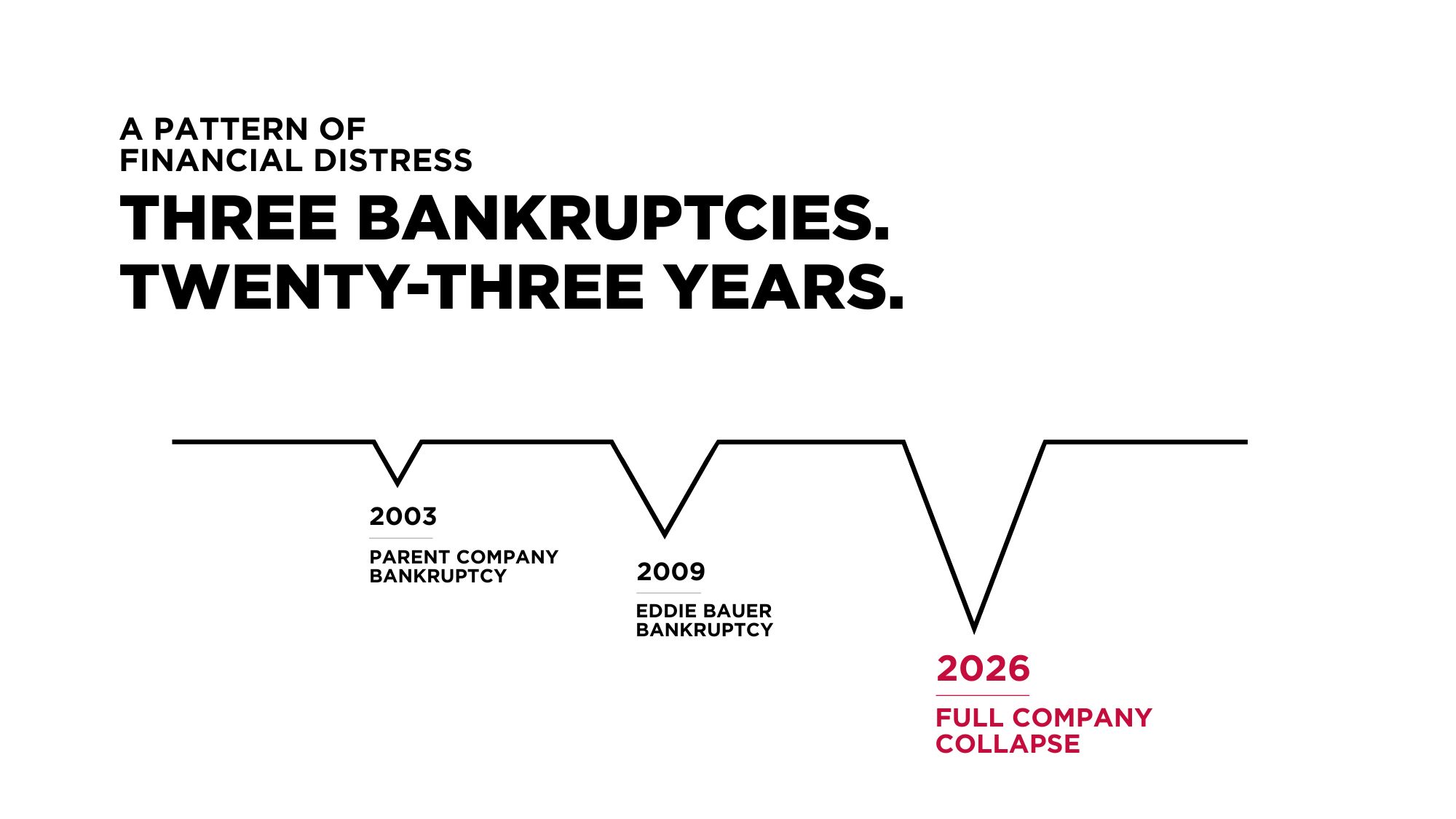
While ownership has gone through further changes since then, these two prior bankruptcies provide important context for the company’s most recent, and most significant, bankruptcy in 2026, marking the end of the company’s brick-and-mortar presence.
What Drove Eddie Bauer to Closure?
With Eddie Bauer’s 2026 bankruptcy and the context behind it now clearly established, we can turn to the factors that led to this moment to better understand what it may signal moving forward.
External Pressures
First, it’s important to look at the broader industry pressures, largely outside of Eddie Bauer’s control, that played a role in shaping its current situation.
Eddie Bauer, like all retailers, has been operating in an environment defined by rising costs and ongoing disruption. In its Chapter 11 filing, the company pointed to factors such as inflation, supply chain disruptions, and tariff uncertainty as key challenges that contributed to more than $1 billion in debt.
These challenges are not unique to Eddie Bauer. A number of retailers, including Party City, Big Lots, At Home, and Saks Fifth Avenue, have faced similar pressures in the 2025–2026 timeframe, with many also resorting to bankruptcy, reinforcing just how widespread these conditions have become.
In addition to these economic pressures, the retail industry is also undergoing meaningful shifts in consumer behavior that are reshaping how and where people spend. As we discussed in our 2026 State of Retail article, many shoppers are becoming more price-conscious. As a result, brands focusing on value are generally outperforming those currently positioned around higher price points and discretionary spending. For a brand like Eddie Bauer, which has traditionally been positioned around higher-quality, higher-priced apparel, this shift added additional pressure that ultimately proved too much to overcome.
Another key shift is the continued growth of e-commerce, which has reduced reliance on physical stores. This is once again reflected in Eddie Bauer’s current situation, as the company moves away from its entire brick-and-mortar presence while maintaining its e-commerce operations.
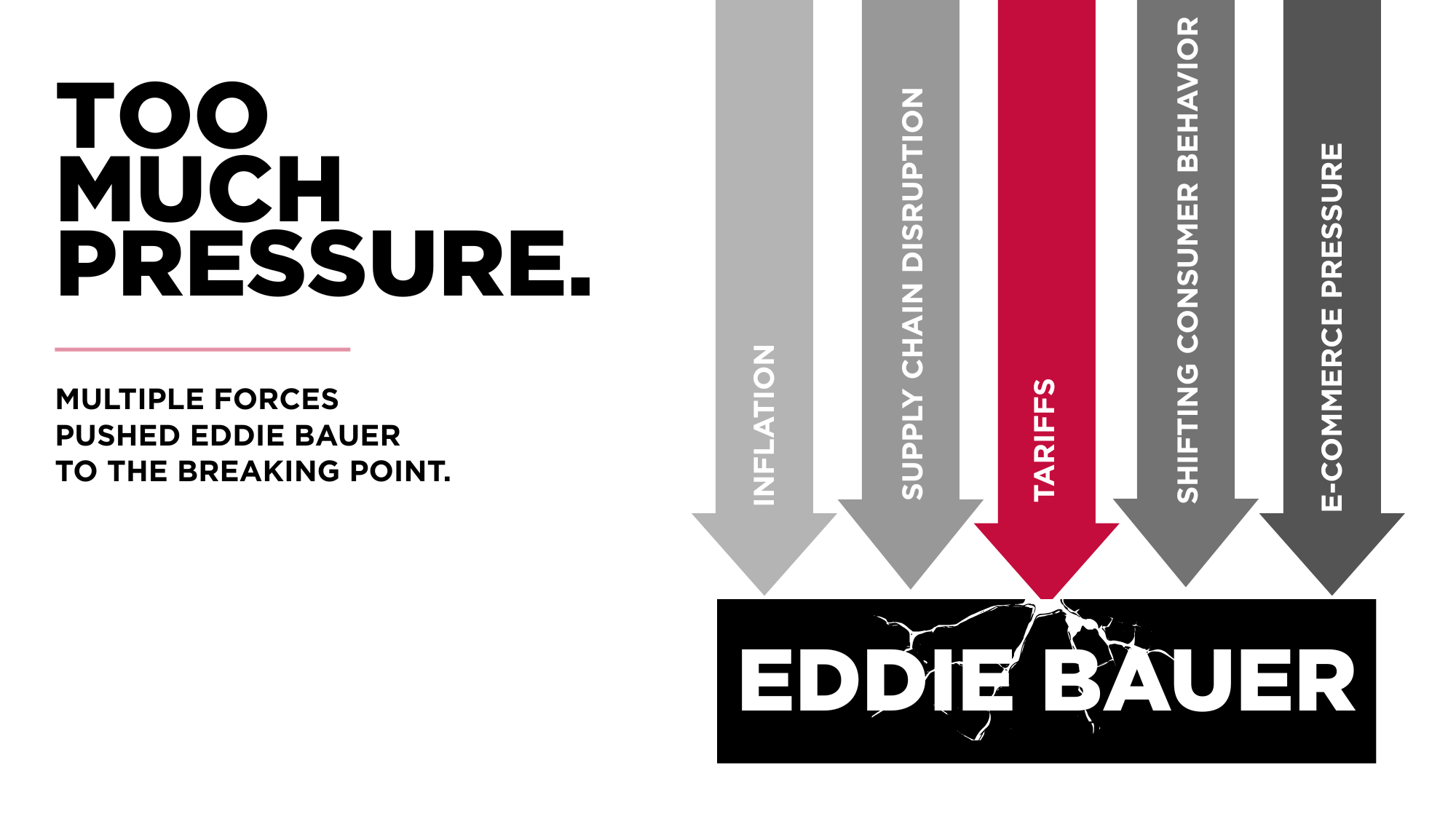
Taken together, these external pressures created a challenging environment not just for Eddie Bauer, but for retailers across the industry.
Strategic Missteps
However, while industry headwinds have made this a difficult time for many retailers, what’s just as important is how leadership responds to those conditions. In Eddie Bauer’s case, several strategic missteps ultimately contributed to its bankruptcy.
In an article by The Street, Benedict Enterprises LLC retail consultant Scott Benedict said, “Eddie Bauer’s exit from physical retail and its subsequent bankruptcy underscore timeless lessons about relevance, investment discipline, and the unforgiving pace of change in apparel retail.” He continued, “Even well-known heritage brands can quickly lose ground when their value proposition no longer aligns with what today’s consumers want, where they shop, and how they engage.”
There are several areas of Eddie Bauer’s recent strategy that reflect that disconnect. First, the brand’s identity became less clear over time, as it shifted away from its roots as a functional outdoor outfitter and toward a more general lifestyle brand. This likely made it harder for customers to identify its unique value.
At the same time, an increased focus on outlet locations may have weakened the brand’s perceived value, as heavy discounting can make products feel less premium and less differentiated. Meanwhile, more technical outdoor brands such as Arc'teryx and Fjällräven gained ground by offering specialized, performance-driven products, making it harder for Eddie Bauer to compete on quality alone.
These challenges were compounded by a loss of relevance with younger consumers, who increasingly viewed the brand as outdated and looked elsewhere for brands that felt more current.
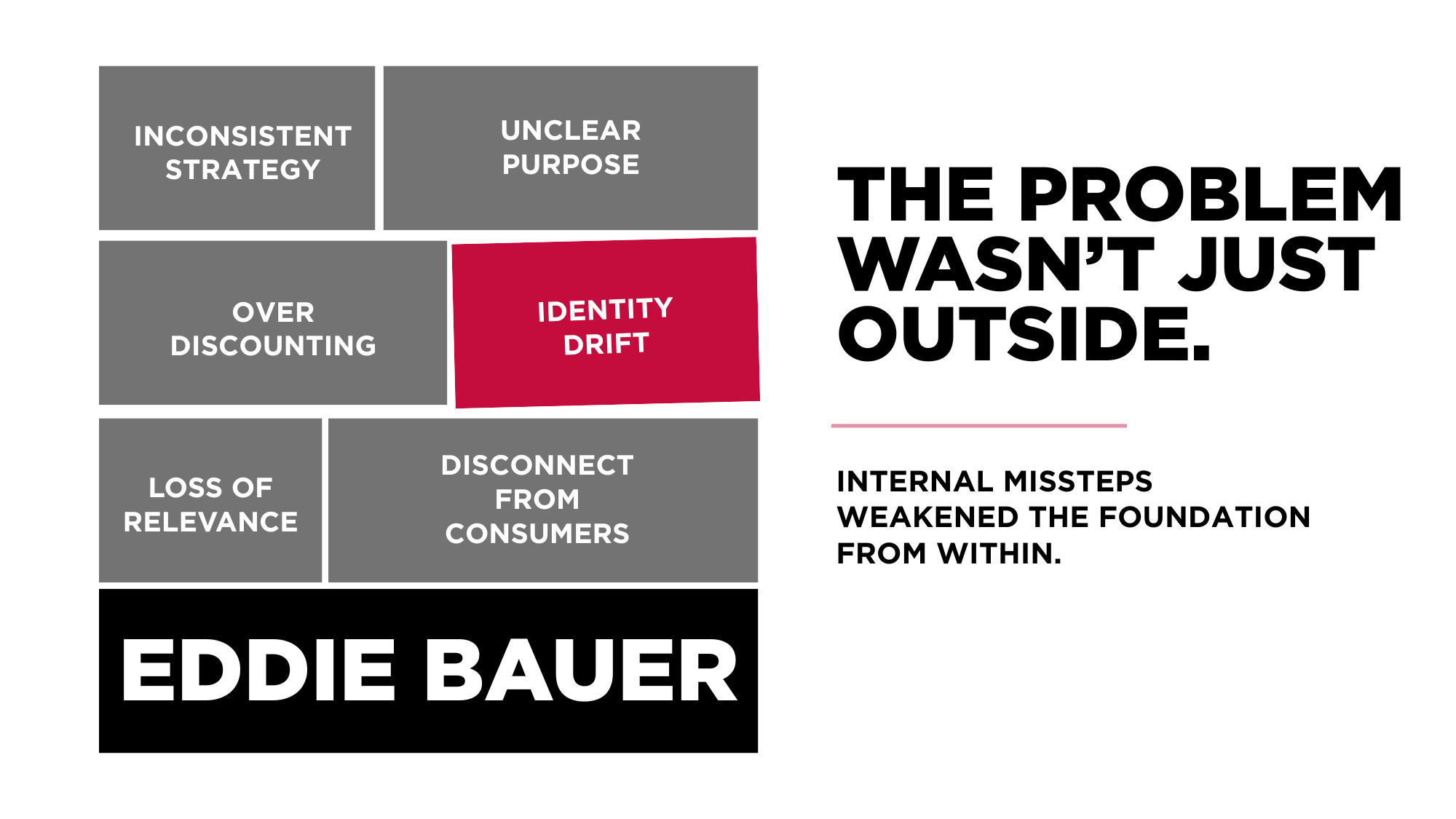
While external pressures certainly played a role in Eddie Bauer’s closures, the company did not stay aligned with the core identity that defined its long history. Instead, its attempts to adapt to changing demands appear to have backfired, contributing to a loss of clarity and relevance.
The Role of Private Equity
One additional factor worth calling out more directly is the role of private equity. As mentioned earlier when covering Eddie Bauer’s bankruptcy history, the company’s ownership has changed multiple times over the past two decades, often as part of broader investment strategies rather than long-term brand-building efforts.
After being acquired out of bankruptcy by private equity firm Golden Gate Capital in 2009, the brand went through several ownership changes, including being grouped with other retailers and folded into larger retail partnerships. Most recently, it became part of Catalyst Brands in 2025 following a merger involving SPARC Group and JCPenney, with backing from major investment firms such as Simon Property Group, Brookfield Corp., Authentic Brands Group, and Shein.
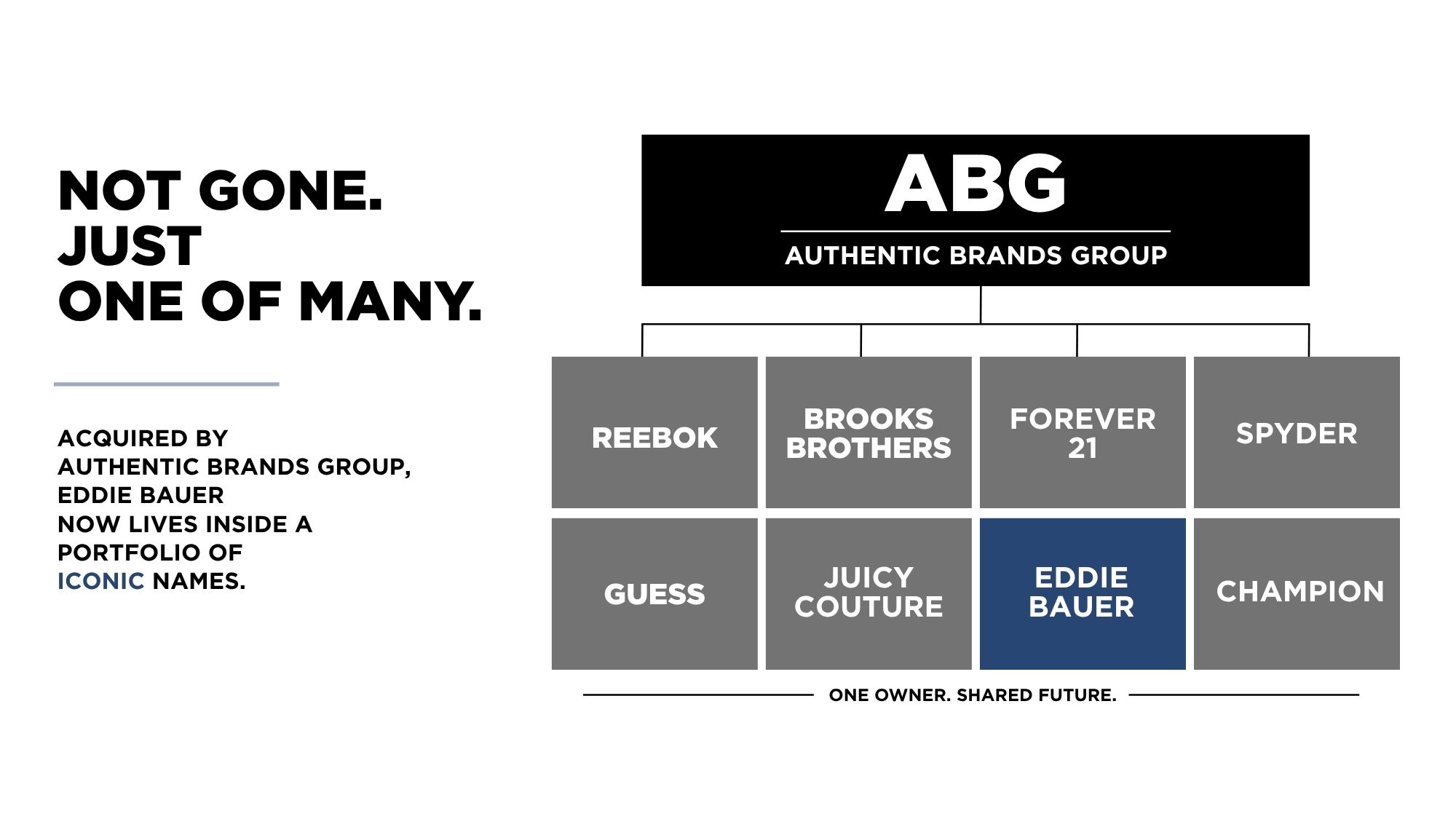
As a result, Eddie Bauer’s structure today does not resemble a traditional retail model. Authentic Brands Group owns the brand itself, while different operators manage different parts of the business.
As we discussed in our 2026 State of Retail article, private equity has become an increasingly influential force across the retail industry, and Eddie Bauer is one example of that trend. These firms often acquire brands, restructure operations, and aim to improve financial performance before eventually exiting the investment. In some cases, their efforts can provide needed capital and stability. In others, it can lead to frequent ownership changes, shifting priorities, and a lack of long-term consistency.
Critics of this model argue that a focus on cost-cutting and financial restructuring can sometimes take priority over sustained brand investment. Over time, that can result in significant operational changes, including restructurings, ownership transitions, and, in some cases, store closures. This pattern may be what unfolded in Eddie Bauer’s case, contributing to its bankruptcy.
While private equity alone does not explain Eddie Bauer’s outcome, it likely played a role in creating conditions that made recovery more difficult.
What's Next for Retail?
In our 2026 State of Retail article, our main takeaway was that while industry forces such as the growing role of private equity and shifting consumer demands would continue to shape the market, the biggest factor in a retailer’s success would be how leadership responds to those challenges. Eddie Bauer’s case strongly reinforces that conclusion.
External forces such as consumers shifting away from higher-priced brands toward value, along with private equity-driven changes in ownership structure, played a role in the company’s decline. However, what ultimately turned that decline into a full-scale closure was how the company responded.
In a previous article, we highlighted how Ollie’s Bargain Outlet has found success by staying disciplined and consistent in its approach, even as the retail landscape continues to shift. Eddie Bauer took a different path, moving away from its core identity by shifting toward a more general lifestyle positioning and leaning into discount-driven channels. In the process, it lost not only clarity, but also relevance with key customer groups.
Retail will continue to evolve, and the pressures facing the industry are not going away. But as we’ve seen, those pressures do not determine the outcome on their own. The retailers that stay grounded in what they do best, while making thoughtful, strategic adjustments, will be best positioned to navigate what comes next.