%25202.avif&w=640&q=75)
Fixture Liquidators vs. Merchandise Liquidators: Don’t Leave Money in a Dumpster
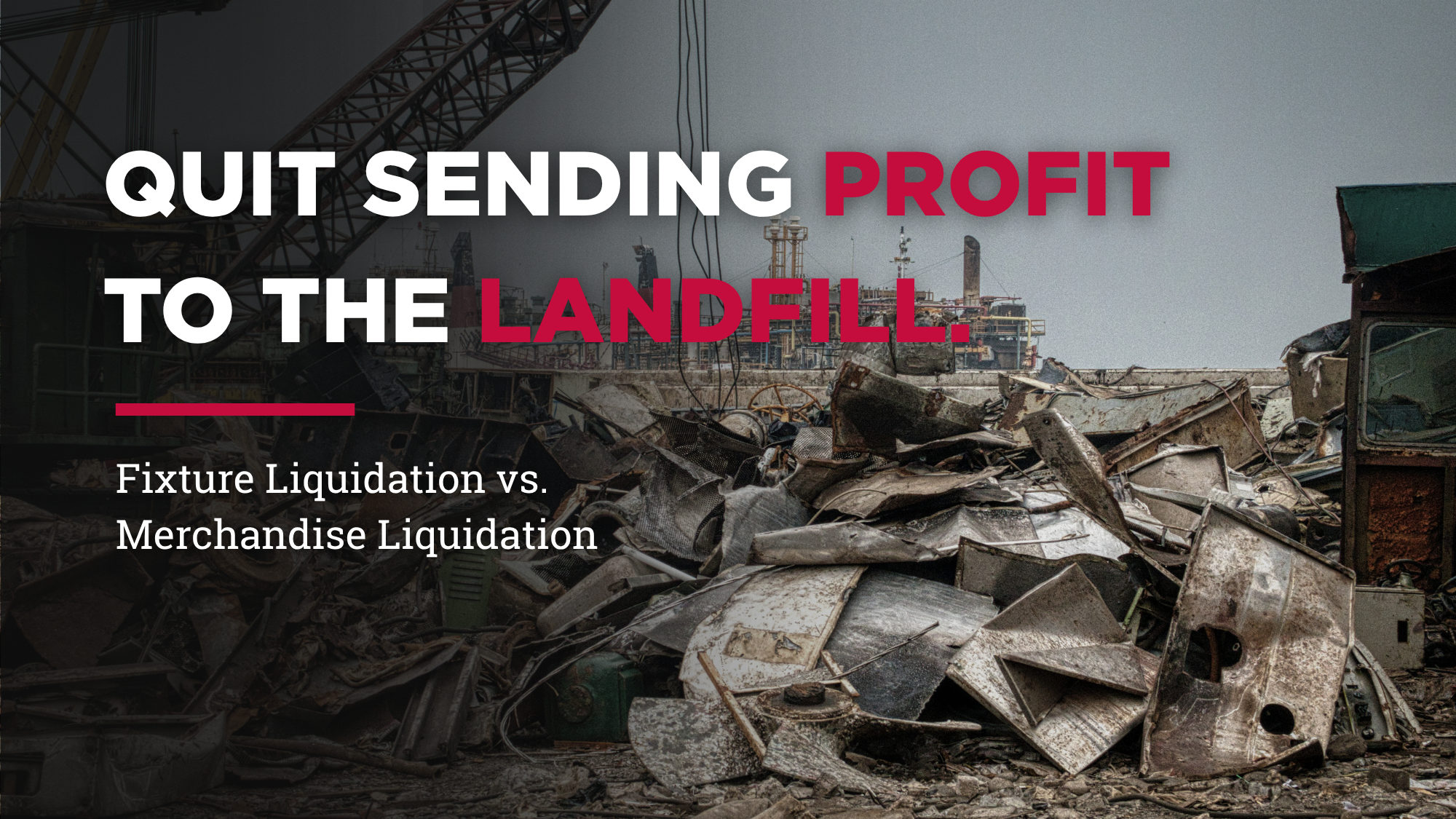
As we covered in our 2026 State of Retail article, large-scale retail closures are accelerating, with no signs of slowing down anytime soon. That reality is leaving many retail executives with important closure-related decisions no one wants to make, but need to be made nonetheless. Among the biggest of those decisions is how to liquidate a closing store, and more specifically, who you hire to handle it.
Many executives turn to merchandise liquidators. And to be clear, merchandise liquidators have their value, but that value doesn’t cover everything. If your space is full of fixtures that need to be sold, recovered, removed, or cleared out, handing that job to the wrong team can become the financial equivalent of throwing money in a dumpster.
That may sound dramatic, but think about it: Who would you rather have perform your hip replacement surgery? Your family physician or a surgeon?
The same logic applies here. Merchandise liquidation and fixture liquidation are not the same job. Merchandise liquidators often promise to clear out your fixtures as well, but that’s not what they’re built to do. When fixtures become the side job in a merchandise liquidation, they often get scrapped unnecessarily or abandoned altogether, causing store owners to lose significant value that could otherwise have been recovered.
At best, you lose potential return. At worst, you’re paying to throw your own money in the aforementioned dumpster.
There’s a better way.
What Merchandise Liquidators Can (and Can't) Do
Before we go in depth on that better way, it’s worth going over what merchandise liquidators can and cannot do, because as we said, they have their value. But that value has limits.
Their standard setup often looks something like this: You bring in a merchandise liquidator at a 10% commission rate. They estimate how much they can recover from the sale, then they price and sell the merchandise. If your goal is simply to move bulk product fast, that setup can work perfectly fine. That’s what merchandise liquidators do best.
But what if fixtures, which are notably not bulk product, make up a large part of your assets?
For most merchandise liquidators, fixtures are an afterthought. In fact, many liquidation contracts give merchandise liquidators the right to abandon fixtures completely. Why? Because they have no real plan, process, or motivation to sell them.
At most, they may cherry-pick the easy stuff, like balers, forklifts, and other big equipment, put up a “fixtures for sale” sign or two, and move on. With a 10% commission on fixture sales, they often don’t feel the need to do more. The real money for them is in the merchandise, so fixtures become an afterthought.
What does this often leave you with? A half-empty building still in need of a full clean-out and broom-sweep. The financial investment you made in your fixtures? Wasted. Gondola shelving, display cases, racks, backroom shelving, and other valuable assets get treated like debris instead of inventory with resale potential.
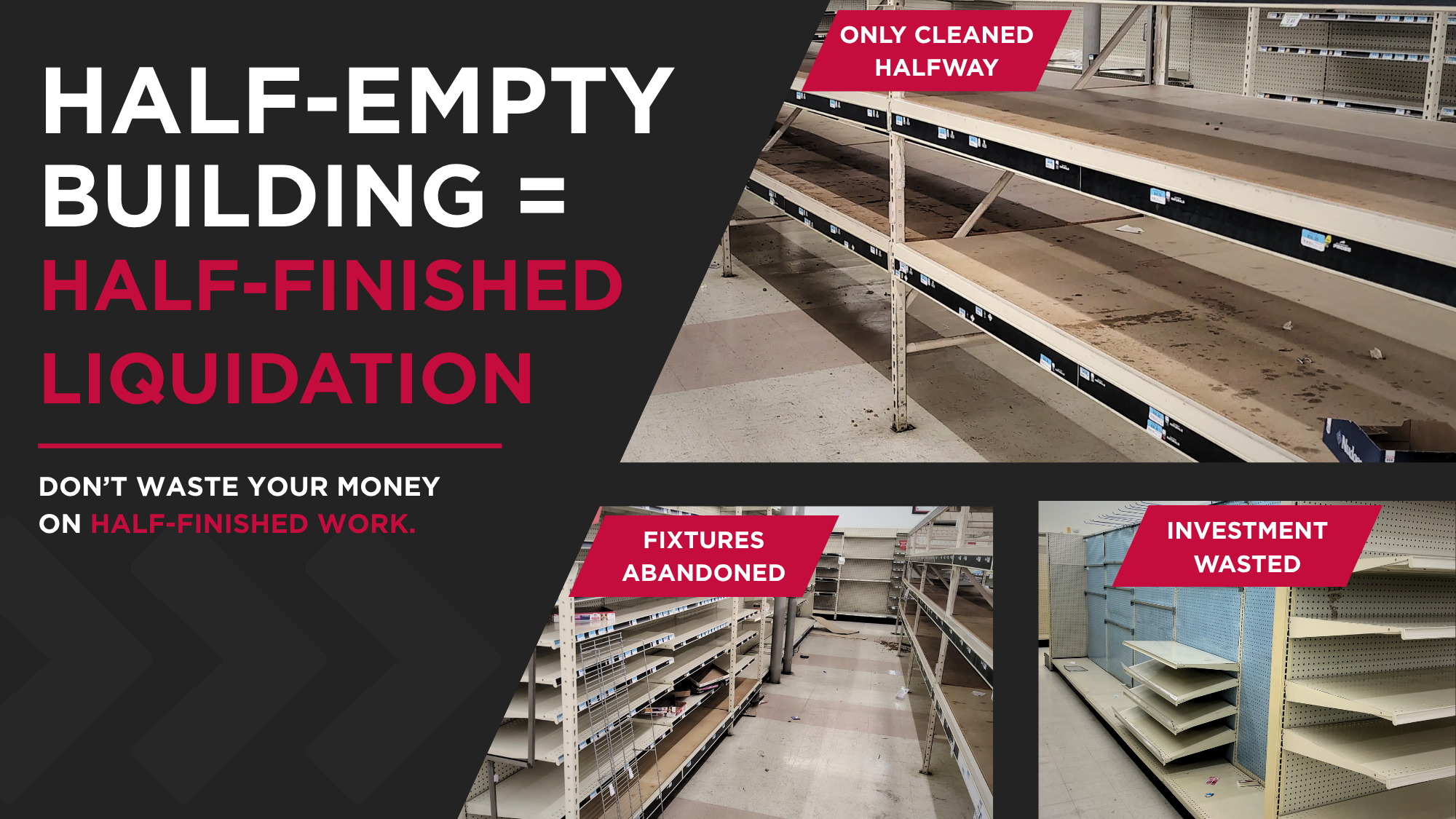
This isn’t us being harsh for the sake of it. It’s reality. Just look at some recent closures around the country for examples. If merchandise liquidators were truly set up to sell fixtures, why were most of JoAnn Fabrics’ fixtures still sitting in stores after liquidation? Why did numerous Big Lots locations still appear to have all of their fixtures left behind after they closed? Why does Rite Aid still appear to have the overwhelming majority of its fixtures sitting in stores after bankruptcy?
The answer is simple: Merchandise liquidators aren’t good at selling fixtures. Not because they’re bad at what they do, but because it’s not what they do.
The Math That Matters
Let’s be honest: when making your decision on who to hire for a liquidation cleanout, you’re not worried about whether your fixtures find a loving new home like a cat you can’t keep because it doesn’t get along with the dog. You’re worried about value. As in, how much do you get back from this process? So, let’s look at the math.
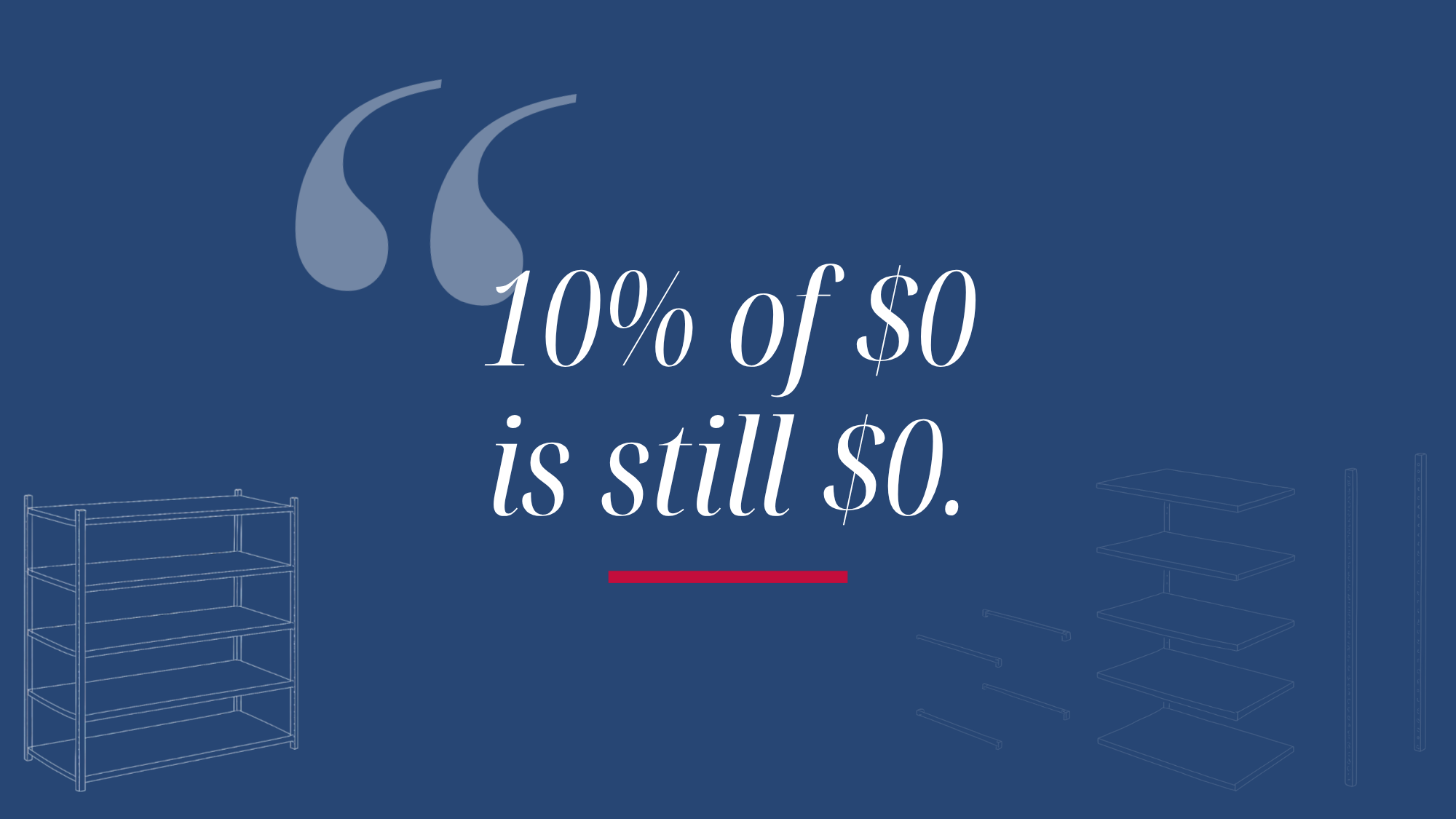
As previously stated, merchandise liquidators typically take a 10% commission on fixture sales. And because their main source of income is selling merchandise, they have little reason to sell your fixtures. Keeping 90% of fixture sales may sound appealing, but that percentage only matters if there are fixture sales to begin with, and that’s not what they specialize in. Unfortunately, 10% of $0 is still $0. Don’t get distracted by a prettier percentage attached to a weaker recovery. It’s fool’s gold.
Here’s a more concrete example that shows the numbers that actually matter: Mid-America Store Fixtures once competed against a merchandise liquidator on a single-store project. We projected $2.5 million in fixture sales. The merchandise liquidator estimated between $500,000 and $1 million. We ended up doing $3 million.
That means the client was comparing 80% of $2.5 million against 90% of $500,000. Do the math. Even before we exceeded our own projection, the better outcome was obvious. The 80% vs. 90% matters significantly less than the $2.5 million vs. the $500,000.
And that’s before factoring in removal costs. When you work with MASF, fixture sales directly offset the cost of the cleanout. Every dollar recovered through fixture sales is a dollar you don’t have to spend on a dumpster, general contractor, or cleanout crew.
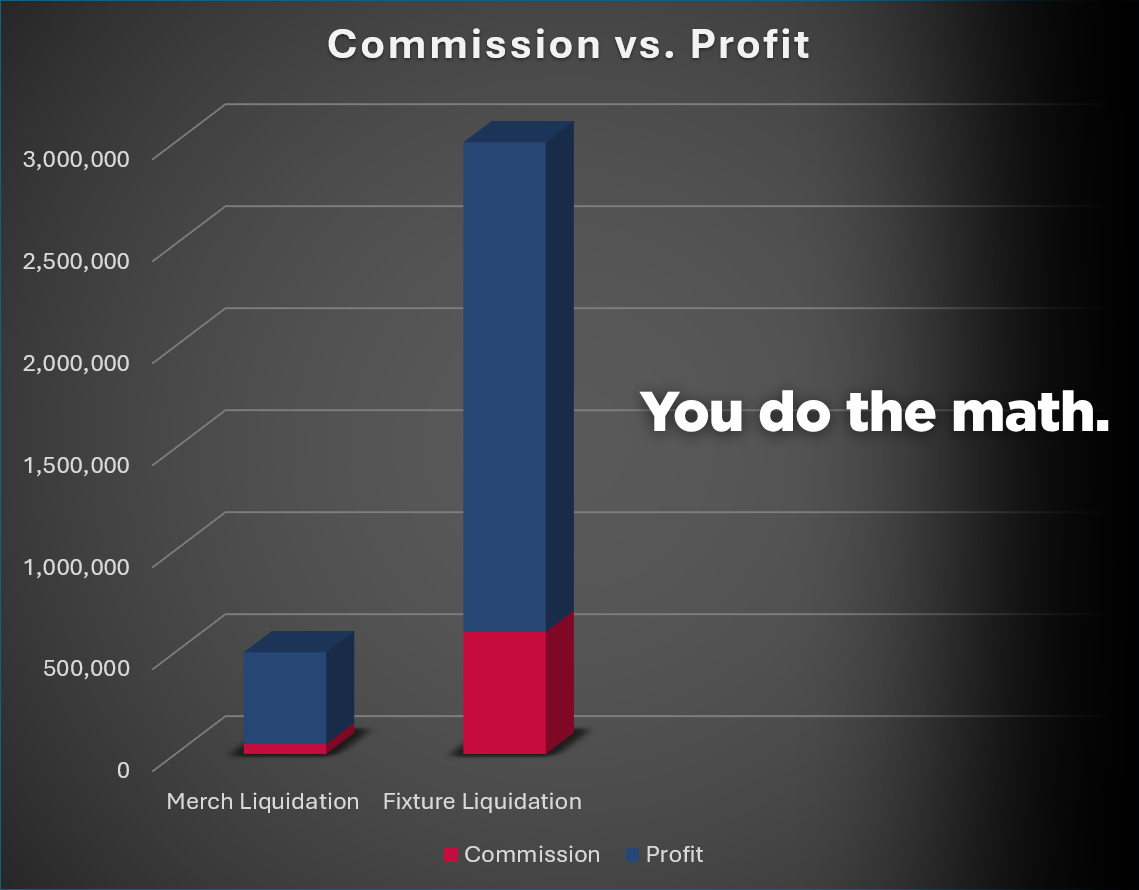
Specialization vs. generalization. Fool’s gold vs. real gold. Any way you frame it, the math points to what actually matters: not the better-looking percentage, but who recovers the most value.
Not Every Specialist Is the Right Specialist
This isn’t just about specialization vs. generalization, however. It’s also about specialization vs. specialization… for the wrong thing.
At the beginning, we posed this question: Who would you rather have perform your hip replacement surgery? Your family physician or a surgeon?
This isn’t to say that a family physician isn’t a specialist. If you hired a family physician to work on your hip, the stitches would probably be done well, the bedside manner would probably be excellent, and the pre- and post-op appointments would likely be a breeze, because those are things they specialize in. None of those, though, are hip replacement surgery, which is what you really need.
It’s the same reason you wouldn’t hire a tire tech to swap out your transmission, hire a demolition crew to renovate your kitchen, or hire a lumberjack to give you a haircut. “A little off the top,” you say. Well, “a little” means something different in their line of work. Let’s just hope they don’t mistake your neck for a trunk.
It all boils down to the same thing: in every high-stakes professional decision, you need a specialist trained specifically for that situation. And a store closure is nothing if not a high-stakes professional decision.

In the case of hip surgery, what do you do? You bring in the right people for the right parts of the job. You let the family physician handle the general care, and you let the hip surgeon handle the surgery. In the case of a liquidation, you should apply the same logic: Hire a merchandise liquidator for the merchandise, and hire a fixture liquidator for the fixtures.
That’s where MASF comes in. Our entire business is store fixtures. Our marketing team is 100% dedicated to fixtures. Our sales team has relationships with fixture buyers nationwide. Our crews know how to pull, pack, and ship gondola shelving, racks, and display cases. That’s the differentiator. Not just a specialist, but the right specialist for the right job.
When You Skip the Specialist: The Hidden Costs of Abandoned Fixtures
As we mentioned earlier, we know that value is the biggest influencer in decisions like this. So, what happens money-wise when you skip the specialist and hire a merchandise liquidator for fixtures?
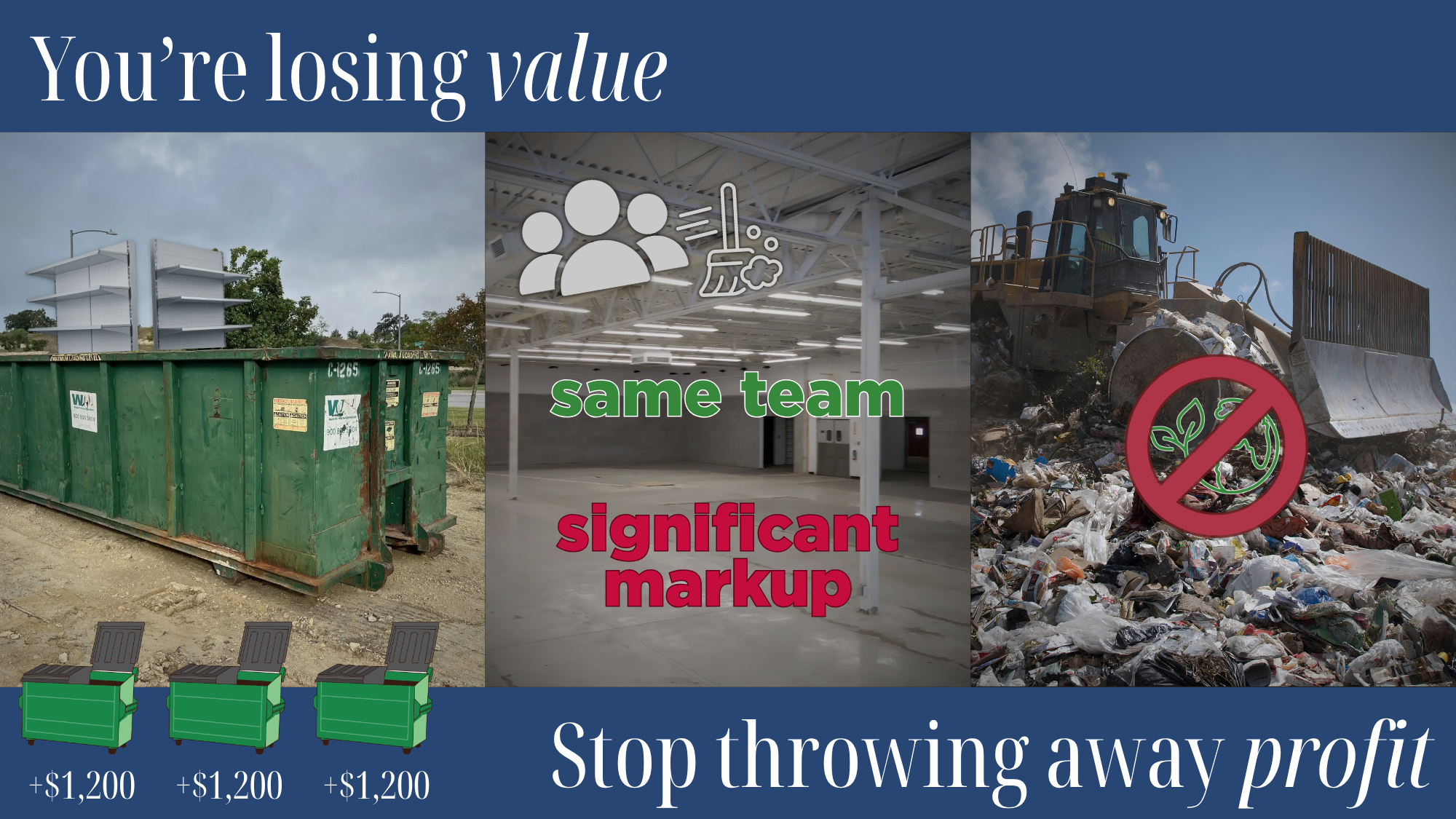
First, the fixtures that don’t sell still have to go somewhere. If they’re abandoned, which happens all too often with merchandise liquidators, the landlord may hire a general contractor to throw everything away. The cost to do that either comes back to you directly or creates friction in your lease exit, which only adds more financial headaches. Either way, those fixtures don’t just disappear. But their value does.
Second, the broom-sweep still has to happen. Merchandise liquidators are not typically built to handle full fixture removal, cleanout, and final site turnover themselves. So, when that work still needs to get done, it often gets hired out, marked up, and then passed along to you as yet another cost. That means you may end up paying a premium for work a fixture specialist would’ve already built into the process.
Third, there’s the environmental cost, which can quickly become a brand-value cost. Every abandoned fixture is a potential landfill fixture. If your company has sustainability initiatives, paying to throw away reusable shelving, racks, displays, and other FF&E works directly against those goals.
For a more practical example, look no further than the cost of dumpsters themselves. When MASF sells and removes fixtures for resale, those fixtures are no longer sitting in the building waiting to be thrown away. That means fewer dumpsters are needed for the final cleanout. Every dumpster MASF helps eliminate through fixture sales can save roughly $700 to $1,200. On a full-store cleanout, those numbers add up quickly. Add in proper scrap and recycling efforts, and the cost-offsetting benefits become hard to ignore.
So, do you want your FF&E treated like an afterthought and abandoned? Or do you want a team proactively working to recover the best value from it because their own profitability depends on that recovery?
If you care about value, as most do, the better approach is clear.
The Better Approach: Hire MASF as Your Store Fixture Liquidation Specialist
Let’s talk directly about why, if you want to recover the most value from your fixtures, hiring MASF is the right call.
To be clear, MASF does not need to replace your merchandise liquidator. In many closures, a merchandise liquidator is already contracted, and that’s fine. Let them handle the merchandise. What MASF does is step in as the fixture specialist your merchandise liquidator would’ve had to hire anyway, just without the markup.
Just like the family physician and hip specialist analogy we emphasized earlier, MASF and merchandise liquidators each have our own specialty, and you need to hire both of us to do our part. I guess you could say, if fixtures were hips, we’d be your hip surgeon. Who wants to bet that’s the first time that sentence has ever been written?
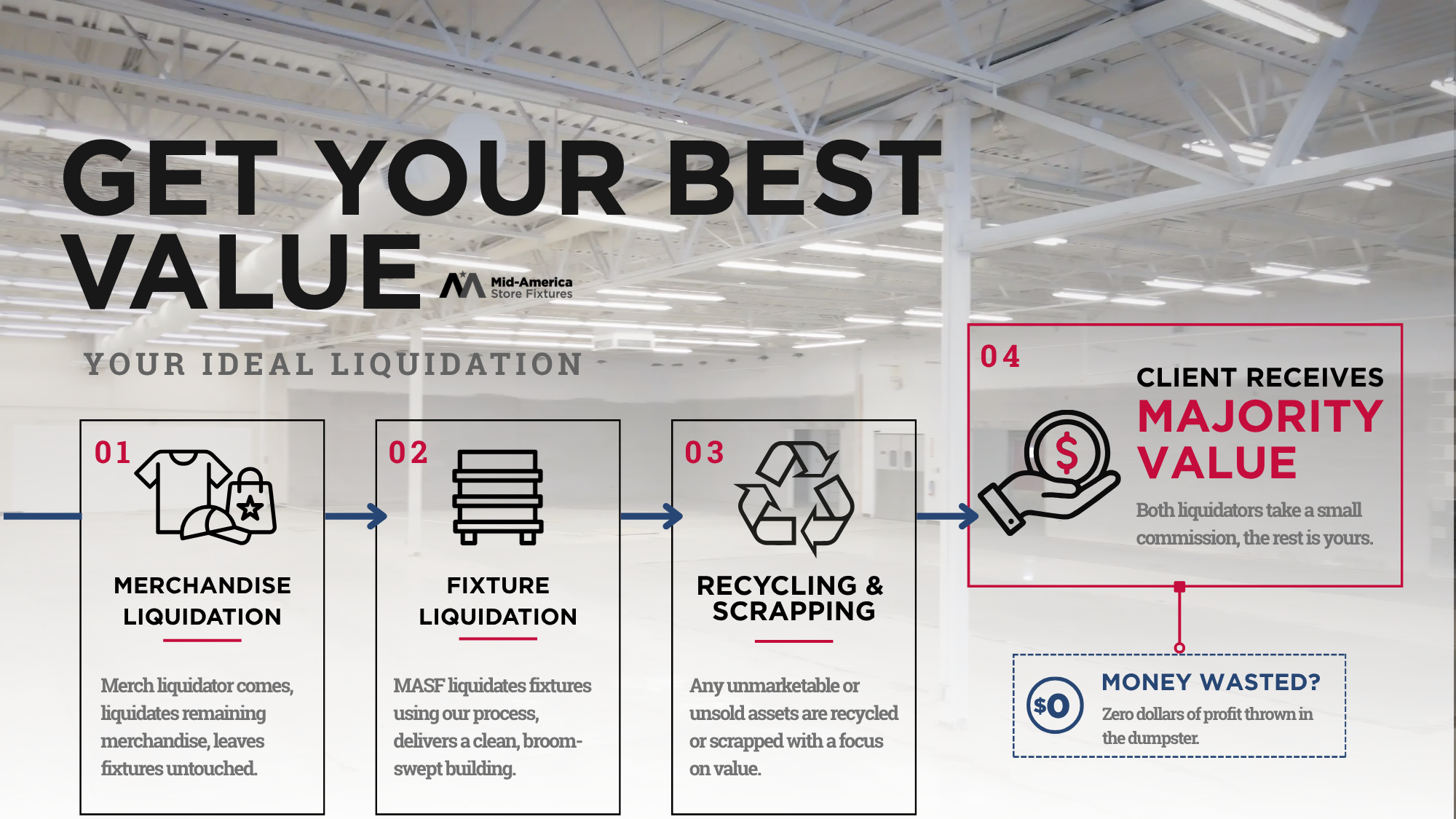
Hiring both of us matters because the best time to sell store fixtures is while the merchandise sale is already happening. Foot traffic is already there, motivated buyers are already walking the store, and fixtures are already visible, accessible, and in context. MASF is built to capitalize on that exact window. How, you ask?
To start, MASF brings fixture-for-sale signage and QR codes that feed into a live bidder list. Buyers can express interest in specific items at specific prices, and our team can follow up with those motivated buyers first. This process turns casual interest into an organized sales process.
MASF also has an in-house sales team actively working on buyer relationships nationwide before items even hit the floor. As the largest stocking used Lozier-style shelving dealer in the U.S., we know the market, we know the buyers, and we know how to move fixture assets efficiently.
Behind that sales effort is an in-house marketing team 100% dedicated to fixtures. Not merchandise. Not general cleanouts. Fixtures. Through direct outreach, regional buyer targeting, and modern marketing tools, MASF creates demand for assets that other liquidators too often leave behind.
Put all of that together, and hiring a specialist makes too much sense to justify going any other way. Why pay someone else to subcontract the expertise, mark it up, and pass it back to you, when you can bring in the team that already does the work? You don’t. Cut out the middleman. You hire MASF and let us do what we do best.
Don't Leave Value in the Dumpster
At the very beginning, we said that handing fixtures to the wrong liquidator can become the equivalent of throwing money in a dumpster. By now, you should see why that wasn’t an exaggeration. Between lost fixture recovery, added cleanout costs, unnecessary landfill waste, and avoidable markups, the fiscal and environmental cases are tied together clearly: choosing MASF helps you avoid leaving money in a dumpster — literally and figuratively.
This post may have been a bit forceful, and the analogies may have gone a little over the top, but that’s only because this is an issue we care deeply about. When valuable fixtures get abandoned, scrapped, or thrown away unnecessarily, retailers lose money they didn’t have to lose. As with all those analogies, there’s a reason you hire a specialist for a specialist’s job. Your store fixtures deserve the same logic.
So, whatever your closure looks like, if you want to keep as much value as possible, reach out to MASF about our fixture liquidation services. We’ll tell you what’s possible.