%25202.avif&w=640&q=75)
What Papa Murphy's Closures Reveal About the Pizza Industry in 2026
For decades, Papa Murphy's has held a unique place in the pizza category, originating the take-and-bake model that emphasized the freshest pizza on the market: made by Papa Murphy's, baked at home. This model built a loyal following across the Pacific Northwest and beyond, but recently, the brand's footprint took another hit as parent company MTY Food Group announced it will close up to 50 corporate-owned Papa Murphy's locations. This comes as part of a broader plan to shutter 68 locations across the brand portfolio, according to reporting by Restaurant Business and Restaurant Dive.
The pressure behind these closures and the pattern they reflect caught our attention here at MASF, as they resonate with what we predicted for the retail market in 2026. Forces like aggressive discounting, rising input costs, and a consumer base with increasingly limited spending have played a role in this wave of recent restaurant closures, and appear to be working against Papa Murphy's as well.
Papa Murphy's joins a growing wave of household names closing locations across the US. Major chains like Pizza Hut and Papa John's have announced hundreds of closures across the country. What's really happening here? Is this a sign of deeper trouble for the restaurant market as a whole, or is the pizza category in a uniquely difficult situation?
Papa Murphy's 2026 Closures: By the Numbers
Papa Murphy's current round of closures came into the public eye in July 2026, when MTY Group CEO Eric Lefebvre told analysts the company would close 68 corporately owned locations across its brand portfolio, including Wetzel's Pretzels, Cold Stone Creamery, and Pinkberry, among others. Of those, approximately 50 locations will be Papa Murphy's stores, according to Restaurant Business, with the first closures beginning the week of July 13th, per Restaurant Dive.
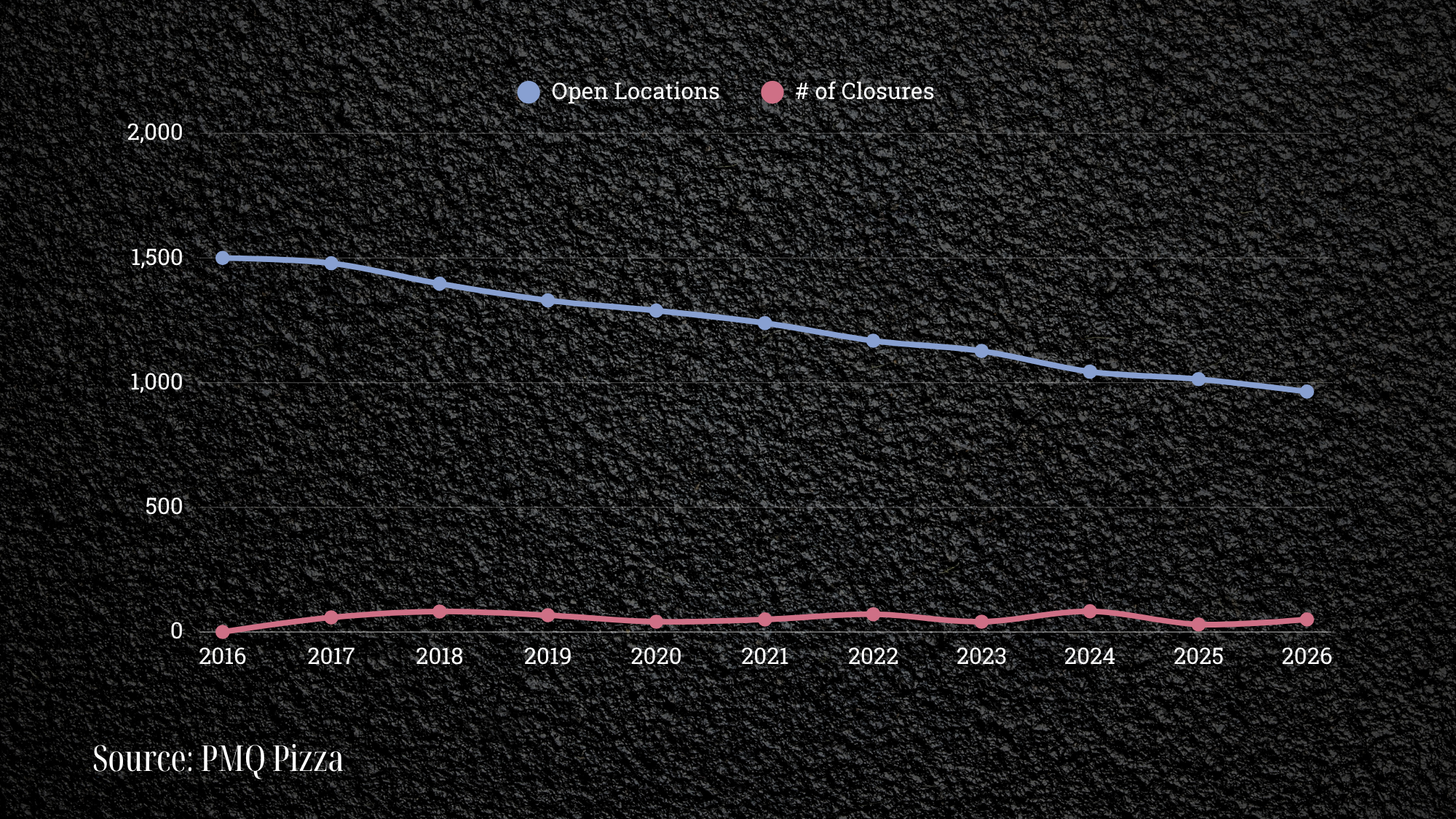
According to Restaurant Business, Papa Murphy's footprint peaked at more than 1,500 stores in 2016, and has since closed roughly a third of its locations. Restaurant Dive, citing the chain's franchise disclosure document, reports that only 1,014 remained by the end of 2025. This round of closures will touch most, if not all, of the remaining corporate holdings owned by MTY, leaving only independently owned franchise locations in operation.
Roughly two years ago, as part of a turnaround effort by MTY, the parent company took over from franchise owners in struggling markets. According to Restaurant Dive reporting, the brand had lost more than $10 million combined prior to the turnaround effort. MTY's same-store sales fell 2.1% companywide last quarter, and Lefebvre acknowledged that without Papa Murphy's, U.S. sales would have been "relatively flat." The 50 closing stores represent only about 1% of MTY's total store base, a reminder that this is a targeted correction rather than a company-wide retreat.
A Legacy Built on a Simple Idea
Company history published by FundingUniverse reveals a unique legacy. Papa Murphy's began as a 1995 merger of two separate, regional take-and-bake pizza chains: Papa Aldo's Pizza and Murphy's Pizza.
The concept was simple, but unique enough to stand out in the market: pizza assembled fresh in-store with real ingredients, then baked at home for the freshest flavor. The difference carried Papa Murphy's a long way. By the time MTY Food Group acquired Papa Murphy's in April 2019 for roughly $190 million, the chain operated 1,331 franchised and 106 corporate-owned stores across 37 states, Canada, and the UAE, generating $809 million in systemwide sales the year before, according to Restaurant Dive's reporting on the deal.
By that time, growth had already begun to exceed the concept's natural market fit. Papa Murphy's expanded well beyond its Pacific Northwest home base into markets where the format's central trade-off—that you still have to cook it yourself—was a harder sell.
Lead-Up to 2026 Closures
With the current situation and history established, we can turn to the unique factors that led Papa Murphy's to this recent wave of closures.
External Pressures
First, it's worth looking at the broader industry pressures working against the chain, located largely outside of MTY or Papa Murphy's control. In recent years, pizza has become one of the most promotion-heavy corners of the restaurant business. Papa Murphy's is arguably one of the worst-positioned brands to compete on price, as noted by their own CEO. "The consumer will go where the pizza is cheapest at any time," Lefebvre told analysts, adding that in the pizza space specifically, Papa Murphy's is "suffering a little bit more than the others" in a category where "there is very little loyalty at the moment," per Restaurant Business.

Rising food costs compound the problem. Lefebvre noted that while labor is "no longer a significant pressure point," rising food costs have taken its place. Chicken, beef, and other core protein costs have risen, particularly impacting Papa Murphy's popular ribs. As consumer wallets feel the squeeze, there is unique pressure on the pizza industry. Lefebvre notes:
That does take away consumer discretionary dollars out of the restaurant space, because it's going into the gas tank.
According to CSP Daily News, citing Black Box Intelligence, restaurant traffic starts declining once gas averages $3.50 per gallon, and falls further, to a nearly 3% decline, once prices clear $3.80. The pain is even sharper for delivery-dependent categories like pizza: according to Food On Demand, citing Gridwise Analytics' 2026 Gas Report, fuel costs consumed as much as 15.6 cents of every dollar gig delivery drivers earned in early 2026, up from 11.2 cents just weeks earlier, making longer deliveries less appealing to drivers and more expensive for the restaurants that depend on them.
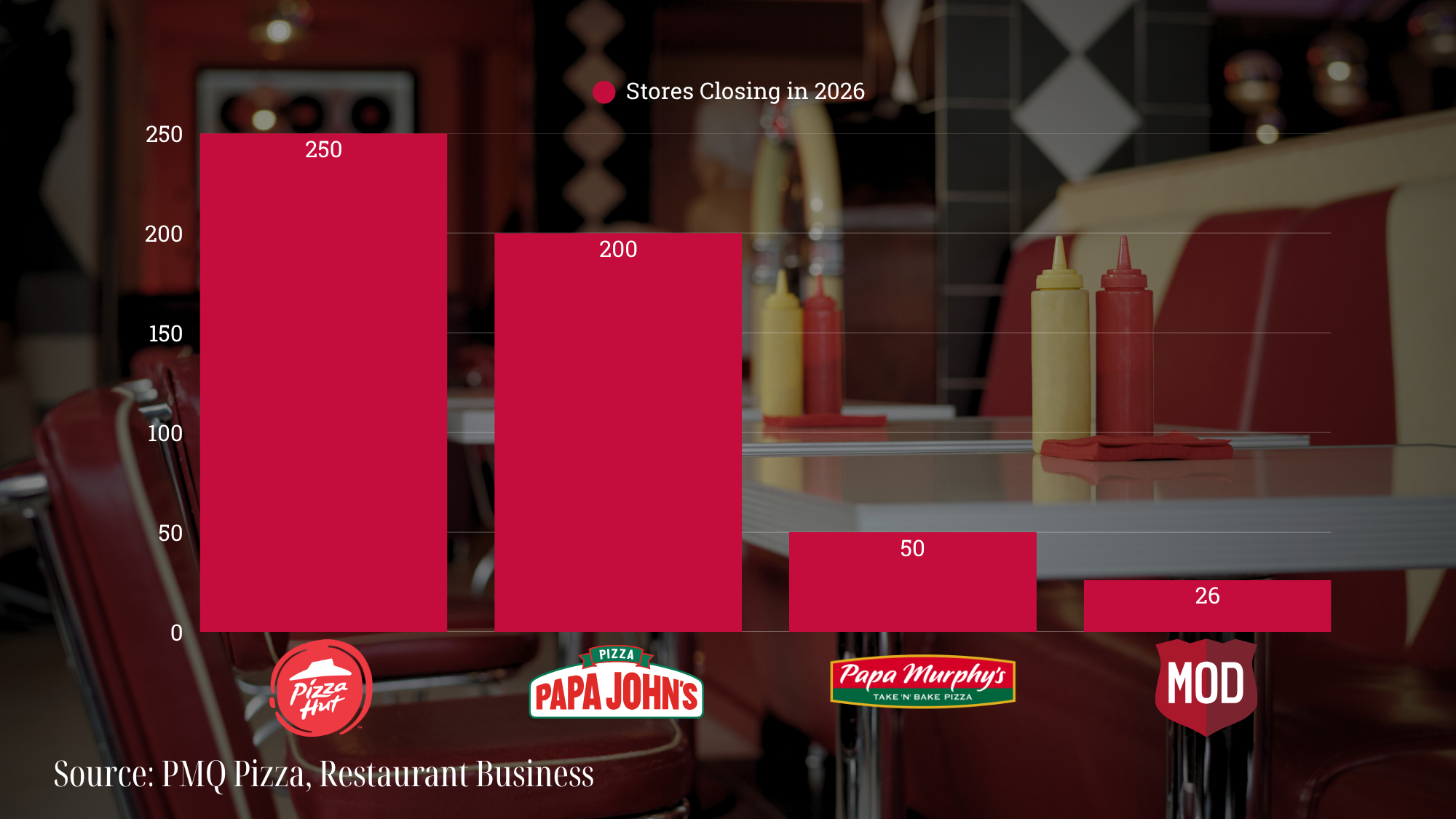
These challenges are not unique to Papa Murphy's. A number of pizza chains, including Pizza Hut and Papa John's, have faced similar pressures in the 2026 timeframe, with Restaurant Dive reporting that Pizza Hut plans to close about 250 U.S. locations in the first half of the year and Papa John's expects to close around 200 restaurants this year alone, part of a larger plan to shutter 300 locations by the end of 2027.
Strategic Missteps
Industry headwinds have made 2026 a difficult stretch for pizza as a category, but a brand's own growth decisions play a similarly pivotal role. In Papa Murphy's case, a rapid, geography-agnostic expansion in earlier decades may have left it with a footprint that did not match demand.
Take-and-bake works well where customers have a strong grasp of the trade-off. Papa Murphy's grew well past the markets where that understanding existed, and where their most loyal fanbase had been built. This mismatch is one of the reasons MTY is now walking back locations that it recently took over from franchisees, locations it concluded, in Lefebvre's words, "were probably not appropriate for Papa Murphy's at this time."
What's Next for Pizza?
There is one conclusion worth returning to, the same one we discussed in our State of Retail 2026 article: leadership matters. How a parent company like MTY chooses to manage a struggling brand, whether it reinvests, retreats, or finds some middle path, will likely matter more to Papa Murphy's future than any single one of these pressures on its own.
Retail and restaurant footprints have always evolved, and pizza will likely be no different. The chains that adapt fastest to a more cost-conscious consumer will be the ones that come out strongest on the other side.
If you're a landlord or property manager facing a closed pizza location or any vacated restaurant space, contact our team to learn how MASF can help.